
Energy Project Management Consulting for Regulated Infrastructure
Energy project management consulting brings control to regulated programs where governance, safety, and documentation are as critical as execution.
AB Consulting supports risk management, planning recovery, and decision frameworks to keep delivery compliant and financially predictable.
Why Energy Project Management Consulting is different
In energy and nuclear, the same delay can trigger several costs: operational, contractual, and regulatory.
Therefore, projects need clear risk ownership, stable planning, and strict interface rules between contractors.
When these elements are missing, reporting becomes noisy and decisions become slow.
Typical challenges
- Planning instability and resource conflicts
- Interface failures between contractors and work packages
- Scope drift due to unclear governance
- Steering committees lacking decision-ready reporting
What AB Consulting sets up
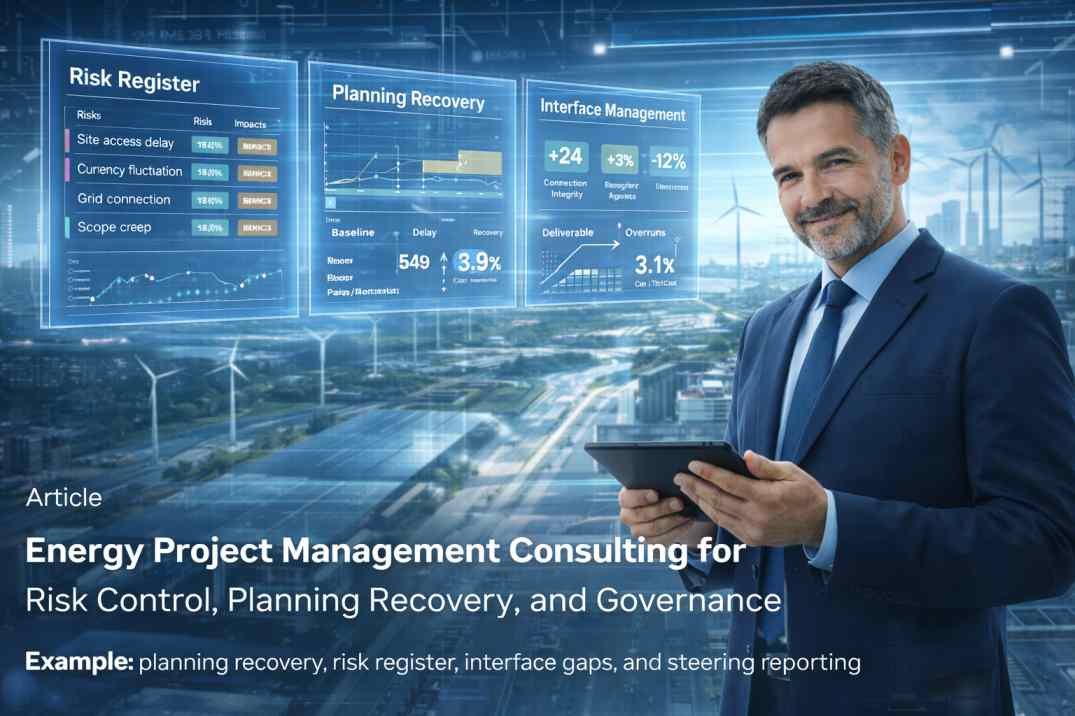
- Risk register with mitigation plans, owners, and cadence
- Planning recovery and critical-path protection
- Interface management: deliverables, gates, acceptance criteria
- Steering committee reporting: decisions, trade-offs, actions
Examples
- Risk register + mitigation plan: top risks, owners, deadlines, and escalation triggers.
- Planning recovery: re-baseline, recovery levers, and resource arbitration rules.
- Interface management: package handoffs, approvals, and clear acceptance criteria.
- Steering reporting: short pack with critical path, cost variance, and decision log.
Cross-links inside AB Consulting
For multi-stakeholder delivery and cost exposure, see
Construction.
For compliance-heavy program steering and supplier networks, see
Aerospace & Defense.
Outbound reference
For nuclear safety and program guidance, see:
IAEA.
Talk to a Consultant
Share your planning status, contractor setup, and top risks. We’ll propose a governance and recovery plan.
FAQ
What does energy project management consulting improve first?
It improves risk ownership and interface rules first. That makes decisions faster and planning more stable.
How do you keep reporting executive-friendly?
We focus on critical path, top risks, cost variance, and decisions required. Everything else is secondary.