
Modern companies increasingly rely on AI analytics tools to transform raw data into actionable business intelligence.
How AI Analytics Tools can Improve Business Intelligence, Forecasting & Decision-Making?
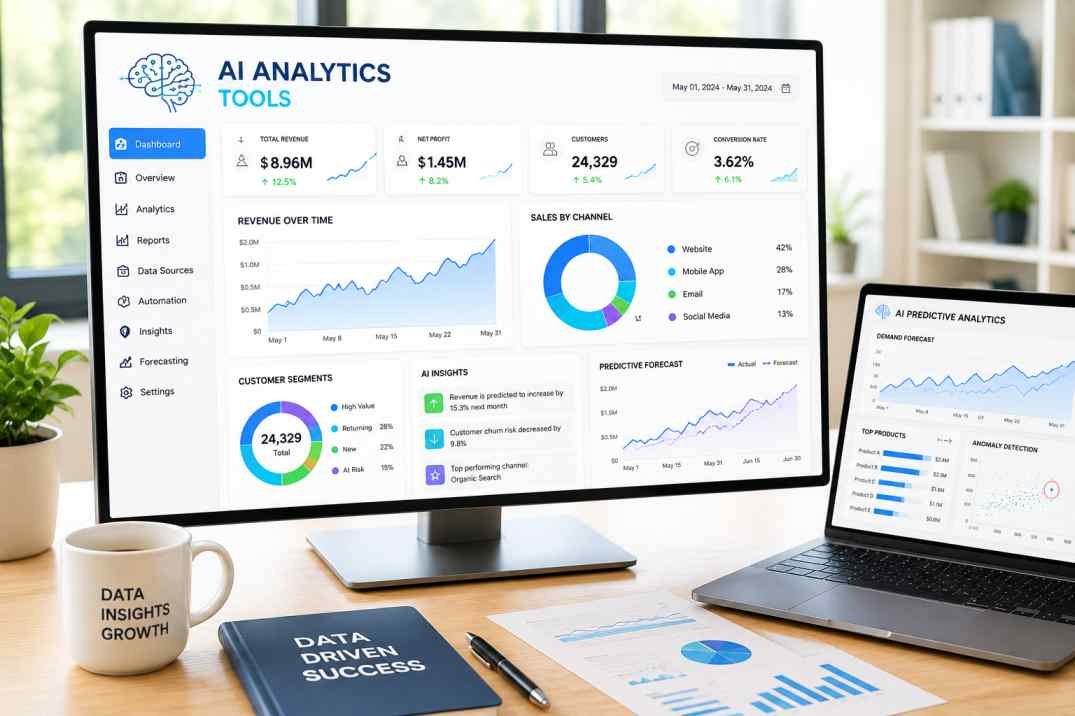
AI-powered analytics platforms help businesses improve forecasting, automate reporting, optimize KPIs, increase operational efficiency, and make smarter data-driven decisions using artificial intelligence and predictive analytics.
1. What Are AI Analytics Tools?
AI analytics tools use artificial intelligence, machine learning, automation, and predictive modeling to analyze large volumes of business data and generate actionable insights.
These tools help companies:
- Automate reporting
- Improve forecasting accuracy
- Detect operational inefficiencies
- Predict customer behavior
- Optimize financial planning
- Improve KPI monitoring
- Reduce operational costs
- Improve strategic decision-making
2. Why AI Analytics Tools Matter?
Traditional reporting systems often rely on manual spreadsheets, delayed reporting, and reactive decision-making.
Professional AI analytics tools allow businesses to:
- Analyze real-time business performance
- Identify hidden trends
- Improve operational visibility
- Reduce human error
- Automate repetitive analysis
- Improve forecasting precision
- Enhance customer insights
Learn more about reporting systems:
reporting and decision-making solutions
3. How AI Analytics Tools Work?
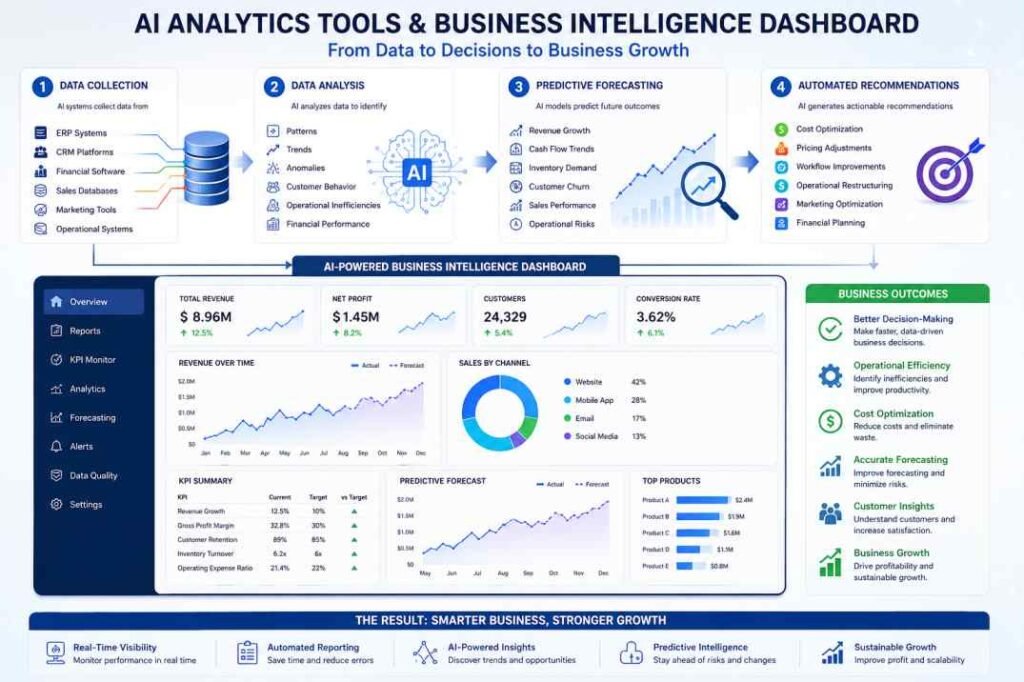
Step 1: Data Collection
AI systems collect data from:
- ERP systems
- CRM platforms
- Financial software
- Sales databases
- Marketing tools
- Operational systems
Step 2: Data Analysis
Artificial intelligence analyzes:
- Patterns
- Trends
- Anomalies
- Customer behavior
- Operational inefficiencies
- Financial performance
Step 3: Predictive Forecasting
AI forecasting models predict:
- Revenue growth
- Cash flow trends
- Inventory demand
- Customer churn
- Sales performance
- Operational risks
Step 4: Automated Recommendations
AI systems generate recommendations for:
- Cost optimization
- Pricing adjustments
- Workflow improvements
- Operational restructuring
- Marketing optimization
- Financial planning
4. AI Analytics Tool Example
Imagine a retail company using modern business intelligence systems to optimize inventory management and sales forecasting.
| Operational Metric | Before AI Analytics | After AI Analytics |
|---|---|---|
| Forecast Accuracy | 68% | 92% |
| Inventory Waste | €120,000 | €45,000 |
| Reporting Time | 15 hours/week | 2 hours/week |
| Annual Operational Savings | — | €220,000 |
The Consultant’s Insight: AI-powered analytic tools transform business data into measurable financial improvements by reducing inefficiencies and improving forecasting precision.
5. KPI Calculations for AI Analytics
Forecast Accuracy Formula
Forecast Accuracy = (1 – |Forecast – Actual| / Actual) × 100
Operational Efficiency Formula
Efficiency Ratio = Output / Input
Example:
- Old reporting time = 15 hours
- New reporting time = 2 hours
Efficiency improvement = 86.6%
6. Popular AI Analytics Tools
- Microsoft Power BI
- Tableau AI
- Google Looker Studio (formerly Google Data Studio)
- SAP Analytics Cloud
- IBM Watson Analytics
- CRM Analytics / Salesforce Einstein Analytics (formerly Einstein Analytics and Tableau CRM)
- Oracle Analytics Cloud
- ChatGPT for data analysis
Learn more about ERP and automation:
ERP enterprise resource planning
7. Common AI Analytics Mistakes
- Poor data quality
- Overcomplicated dashboards
- Ignoring KPI alignment
- Insufficient employee training
- Overreliance on automation
- Weak data governance
- No strategic implementation plan
Modern business intelligence systems only perform effectively when businesses combine quality data with strategic operational management.
Need AI Analytics Consulting?
At Consultant4Companies, we help organizations implement AI analytics tools, automate reporting systems, optimize KPI monitoring, improve forecasting accuracy, and increase operational efficiency through intelligent data analysis.