Managing Personal Finances: Complete Guide to Budgeting, Saving, Investing & Financial Stability
Managing personal finances is one of the most important life skills for achieving financial stability, reducing stress, and building long-term wealth. Without proper financial management, people often struggle with debt, poor budgeting, low savings, and financial insecurity.
Good financial management helps you:
- Control spending
- Reduce debt
- Build emergency savings
- Improve financial security
- Increase wealth over time
- Prepare for retirement
- Achieve personal financial goals
At Consultant4Companies, we help individuals and businesses improve budgeting, forecasting, cash flow management, and financial planning strategies.
Why Managing Personal Finances Matters?
Poor financial management creates stress, uncertainty, and long-term financial problems. Many people earn good incomes but still struggle financially because they lack budgeting discipline and financial planning.
Managing personal finances helps you:
- Track income and expenses
- Build savings
- Avoid unnecessary debt
- Improve cash flow
- Prepare for emergencies
- Grow investments
- Create long-term financial security
Financial discipline is not about becoming rich quickly. It is about making consistent smart decisions over time.
Read also:
Proactive Approach Mastery
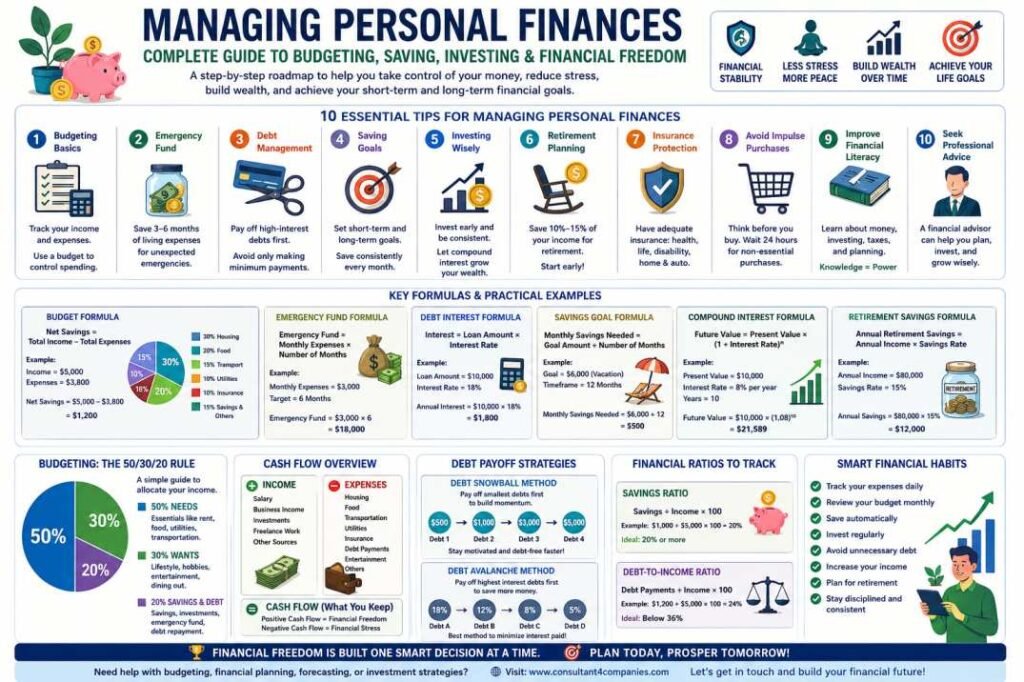
10 Essential Tips for Managing Personal Finances
Financial discipline is not about becoming rich quickly. It is about making consistent smart decisions over time. Here are the 10 essential tips:
1. Budgeting Basics
The first step in managing personal finances is creating a detailed budget.
A budget helps you understand:
- How much money you earn
- How much money you spend
- Where your money goes
- How much you can save
Monthly Budget Formula
Net Savings = Total Income – Total Expenses
Budget Example
- Monthly income = $5,000
- Monthly expenses = $3,800
Net Savings = $5,000 – $3,800 = $1,200
This means you save $1,200 every month.
You can use budgeting apps or spreadsheets to track spending categories like:
- Rent or mortgage
- Utilities
- Food
- Transportation
- Entertainment
- Insurance
- Savings
Read also:
Budgeting toolkit with Excel examples
2. Build an Emergency Fund
An emergency fund protects you against unexpected financial problems like:
- Job loss
- Medical emergencies
- Car repairs
- Unexpected bills
Most financial experts recommend saving between three and six months of living expenses.
Emergency Fund Formula
Emergency Fund = Monthly Expenses × Number of Months
Example
- Monthly expenses = $3,000
- Emergency target = 6 months
Emergency Fund = $3,000 × 6 = $18,000
This emergency reserve creates financial security and reduces dependence on credit cards or loans.
3. Debt Management
High-interest debt is one of the biggest financial problems for individuals.
Prioritize paying off:
- Credit card debt
- Personal loans
- High-interest financing
Always focus first on debts with the highest interest rates.
Debt Interest Formula
Interest = Loan Amount × Interest Rate
Example
- Credit card debt = $10,000
- Interest rate = 18%
Annual Interest = $10,000 × 18% = $1,800
Paying off high-interest debt quickly can save thousands of dollars.
Read also:
Wealth management guide
4. Set Saving Goals
Saving goals create motivation and financial direction.
Examples include:
- Vacation savings
- Buying a car
- Buying a house
- Retirement savings
- Education funds
- Business investment
Savings Goal Formula
Monthly Savings Needed = Goal Amount / Number of Months
Example
- Vacation budget = $6,000
- Timeframe = 12 months
Monthly Savings Needed = $6,000 / 12 = $500
Clear goals make saving easier and more disciplined.
Read also:
SMART goals and objectives
5. Learn About Investing
Investing helps money grow over time through compound growth.
Common investments include:
- Stocks
- Bonds
- Mutual funds
- ETFs
- Real estate
- Retirement accounts
Compound Interest Formula
Future Value = Present Value × (1 + Interest Rate)^Years
Investment Example
- Investment = $10,000
- Annual return = 8%
- Investment period = 10 years
Future Value = $10,000 × (1.08)^10 = $21,589
This shows how compound growth can significantly increase wealth over time.
6. Retirement Planning
The earlier you start saving for retirement, the more time your investments have to grow.
Financial advisors often recommend saving 10% to 15% of annual income for retirement.
Retirement Savings Formula
Annual Retirement Savings = Annual Income × Savings Rate
Example
- Annual income = $80,000
- Savings rate = 15%
Retirement Savings = $80,000 × 15% = $12,000 per year
Starting early reduces the pressure to save large amounts later.
7. Insurance Protection
Insurance protects your finances against major financial risks.
Important insurance types include:
- Health insurance
- Life insurance
- Disability insurance
- Home insurance
- Car insurance
Without insurance, a single emergency can destroy years of savings.
8. Avoid Impulse Purchases
Impulse spending destroys budgets and delays financial goals.
Before buying non-essential items:
- Wait 24 hours
- Compare prices
- Ask if the purchase is necessary
- Check your monthly budget first
Impulse Spending Example
- Impulse purchases per month = $300
Annual unnecessary spending = $300 × 12 = $3,600
Small unnecessary expenses become large financial losses over time.
9. Improve Financial Literacy
Financial literacy means understanding money management.
Learn about:
- Budgeting
- Investing
- Taxes
- Debt management
- Retirement planning
- Cash flow
- Risk management
The more financial knowledge you have, the better your financial decisions become.
10. Seek Professional Advice
Professional financial advisors can help create personalized strategies.
They can assist with:
- Investment planning
- Retirement planning
- Tax optimization
- Debt reduction
- Estate planning
- Budget optimization
Professional advice often helps people avoid expensive financial mistakes.
Common Personal Finance Mistakes
- Living beyond your income
- Not saving for emergencies
- Ignoring retirement planning
- Using too much credit card debt
- Making impulse purchases
- Not tracking expenses
- Investing without research
- Not having financial goals
- Ignoring insurance protection
- Depending only on one income source
Avoiding these mistakes significantly improves financial stability.
Best Financial Ratios for Personal Finance
Savings Ratio
Savings Ratio = Monthly Savings / Monthly Income × 100
Example
- Monthly savings = $1,000
- Monthly income = $5,000
Savings Ratio = ($1,000 / $5,000) × 100 = 20%
Debt-to-Income Ratio
Debt-to-Income Ratio = Monthly Debt Payments / Monthly Income × 100
Example
- Monthly debt payments = $1,200
- Monthly income = $5,000
Debt-to-Income Ratio = ($1,200 / $5,000) × 100 = 24%
Lower debt ratios improve financial flexibility.
Related Financial Resources
Need Help Managing Your Finances?
At Consultant4Companies, we help individuals and businesses improve budgeting, financial planning, investment analysis, cash flow management, and long-term financial strategies.