
Strategic ERP Property Management Integration: Bridging the Gap Between Operations and Finance
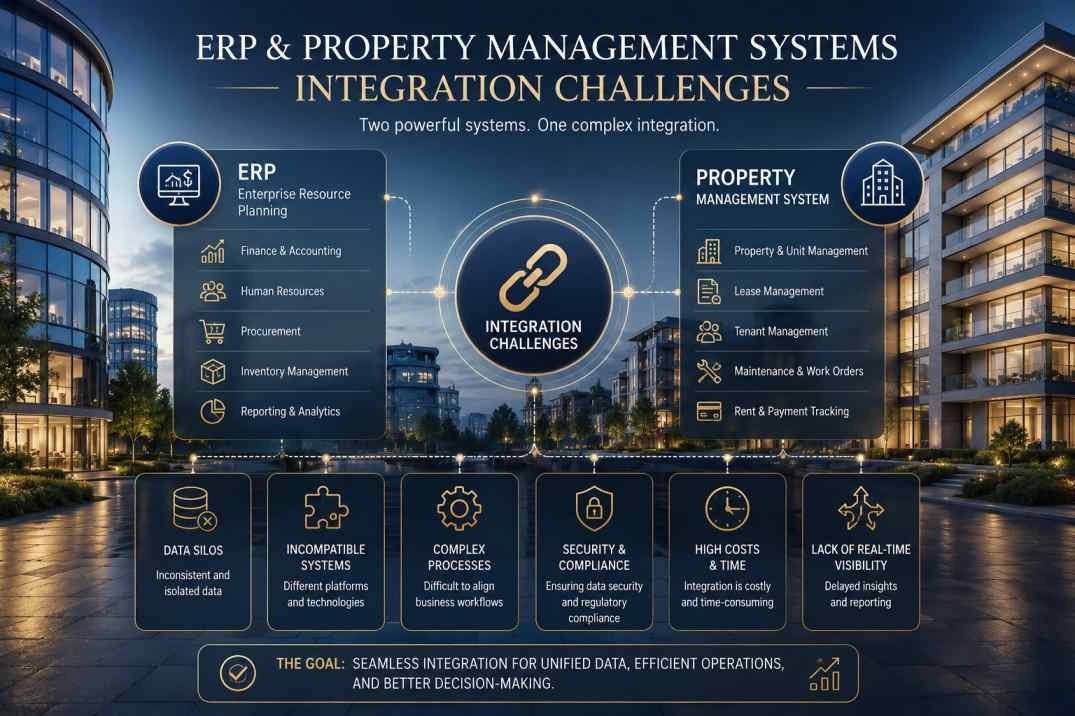
In the realm of international real estate, ERP property management integration is the linchpin of institutional scalability. For global investors, the challenge isn’t just “connecting software”, it is ensuring that a lease signed in Berlin or a maintenance invoice paid in Dubai flows perfectly into a corporate ERP (like SAP, Oracle, or Microsoft Dynamics) in London, Paris or New York.
At Consultant4Companies (C4C), we eliminate the data gaps that erode your Internal Rate of Return (IRR). We provide the forensic-level oversight and system architecture required to turn your digital infrastructure into a high-performance asset.
1. The 4 Core Pillars of Successful ERP/PMS Integration
True ERP property management integration requires more than a technical API connection; it requires a harmonization of your operational and financial data models.
- Data Synchronization (The “Single Source of Truth”): Ensuring that the Rent Roll (local operations) in your PMS perfectly matches the General Ledger (corporate finance) in your ERP to prevent reconciliation “nightmares.”
- Multi-Currency & Tax Harmonization: Automating the conversion of local operational data into corporate reporting currencies while maintaining local VAT/GST compliance.
- Automated Accounts Payable (AP) Workflows: Streamlining vendor payments from the property level to the corporate treasury without manual re-entry.
- Consolidated Investor Reporting: Providing a real-time “look-through” from the portfolio level down to the individual asset performance.
2. The Math of Integration: The Error-Correction Multiplier
As a Financial Director, we monitor the Cost of Manual Intervention (CMI). Every hour spent manually reconciling data between systems is a direct hit to your Operating Expense Ratio (OER).
The Integration Efficiency Formula
Efficiency Gain (%) = [(TManual – TAutomated) / TManual] × 100
Where T represents the time spent on monthly financial closing and reporting.
3. Example Calculation: The ROI of “Straight-Through Processing”
Imagine a portfolio of 5,000 units across five countries. Before C4C’s (Consultant4Companies) intervention, the finance team spent 120 hours monthly on manual reconciliation.
| Performance Metric | Pre-Integration (Manual) | Post-Integration (C4C) |
|---|---|---|
| Monthly Reporting Hours | 120 Hours | 10 Hours |
| Annual Labor Cost (@ €75/hr) | €108,000 | €9,000 |
| Bad Debt / Error Leakage | €45,000 (est.) | €2,000 (forensic) |
| Total Annual Value Preserved | — | €142,000 |
The “Transparency Premium”
Beyond the €142,000 in savings, integration provides Financial Velocity. Closing your books in 3 days instead of 15 allows you to move capital faster. This level of transparency can lower your cost of debt by 10–25 basis points, as lenders view integrated portfolios as lower risk.
The Director’s Insight: Beyond the €142k in annual savings, this integration provides Financial Velocity. The ability to close your books in 3 days instead of 15 days allows for faster capital recycling and provides a “Transparency Premium” that can lower your cost of debt by 10-25 basis points.
Stop Fighting Your Data. Start Scaling Your Portfolio.
Is your corporate finance team drowning in manual spreadsheets from local property managers? Disconnected systems are the number one cause of operational failure in international real estate. At Consultant4Companies, we provide the forensic system audits and integration strategies required to unify your global operations. Let us help you turn your digital infrastructure into a high-performance asset.