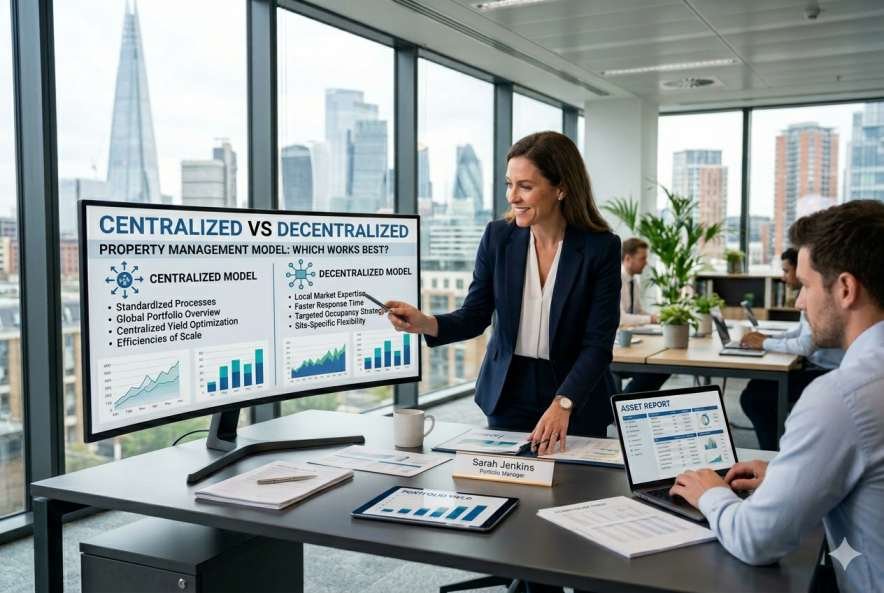

The Best Property Management Model: Engineering Institutional Yield and Efficiency
In the global real estate sector, selecting the best property management model is a high-stakes fiduciary decision. The structure you choose directly impacts your portfolio’s Operating Expense (OpEx) ratio, the velocity of your reporting, and ultimately, the capitalization rate (Cap Rate) applied by investors. At Consultant4Companies, we align your organizational DNA with your yield requirements to turn property management from a cost center into a value-creation engine.
1. Analyzing the Core Management Models: A Financial Perspective
Every international portfolio requires a different balance of control and agility. Selecting the best property management model depends on your geographic density and asset complexity.
A. The Centralized Property Management Model
This model concentrates high-level functions like procurement, finance, accounting, and compliance at a Corporate Shared Services Center.
- Best for: Geographically clustered assets, standardized multi-family portfolios, and REITs.
- Management Alpha: Achieved through bulk purchasing power and the elimination of redundant local administrative roles.
Examples
This model thrives on repeatability and scale. It treats property management like a finely tuned machine where the “brain” sits at headquarters.
- Student Housing Portfolios: Large-scale providers (like those serving major university systems) often centralize leasing platforms and maintenance ticketing. By using a single call center for 10,000+ beds, they ensure brand consistency and lower the cost per lease.
- Industrial/Logistics Parks: A REIT owning 50 identical warehouses across a region doesn’t need 50 independent accounting teams. Centralization allows for “triple-net” (NNN) lease audits and structural insurance procurement to be handled by a single specialist team.
- Affordable Housing Networks: Compliance with government subsidies (like LIHTC in the US) is legally complex. Centralizing the compliance and “income certification” process ensures the owner doesn’t lose tax credits due to a mistake made by an individual site manager.
B. The Decentralized Property Management Model
This model empowers on-site managers with the autonomy to manage budgets, vendor relationships, and tenant life-cycles locally.
- Best for: High-touch hospitality assets, luxury serviced apartments, and unique mixed-use developments.
- Management Alpha: Achieved through superior local responsiveness that drives Net Promoter Scores (NPS) and justifies rental premiums.
Examples
This model thrives on nuance and relationships. It treats property management like a boutique service where the “brain” is on the ground.
- Luxury Retail High-Streets: Managing storefronts on the Champs-Élysées or 5th Avenue requires deep roots in the local community. On-site managers must curate “pop-up” events and maintain personal relationships with high-end brand directors to ensure long-term renewals.
- Medical Office Buildings (MOBs): Healthcare tenants have highly specialized needs, from biohazard disposal to specific HVAC requirements for surgery centers. A local manager with technical expertise can respond to a “code red” facility issue much faster than a remote corporate office.
- Co-Working & Flex-Space Operators: The “product” here is the community. A decentralized approach allows the local “Community Manager” to pivot the budget toward events that specifically resonate with their unique set of members (e.g., tech founders vs. creative freelancers).
2. The Math of Management: Calculating Efficiency
To identify the best property management model, we utilize the Operating Expense Ratio (OER) and Net Yield Analysis. A structural shift in management should always result in an OER Compression.
The Operating Expense Ratio (OER) Formula
OER = (Total Operating Expenses / Effective Gross Income) × 100
Institutional Target: Under 35–40% depending on asset class. A centralized model targets a lower OER through “Back-Office” consolidation.
The Efficiency Gain Multiplier
We measure the financial benefit of centralization using the labor-cost delta:
Labor ROI = (Pre-Centralization Labor Cost – Post-Centralization Labor Cost) / Implementation Cost
3. Example Calculation: The “Centralization Arbitrage”
Consider an international portfolio with 20 properties across three regions. By shifting to a hybrid model, we consolidate regional accounting while maintaining local leasing agents.
| Metric | Decentralized (Old) | Hybrid (Optimized) |
|---|---|---|
| Admin/Accounting Staff | 20 Staff (@ €50k) | 4 Staff (@ €75k) |
| Annual Labor Cost | €1,000,000 | €300,000 |
| Procurement Savings | Baseline | €150,000 (Bulk Leverage) |
| Total Annual NOI Increase | — | €850,000 |
The Director’s Insight: An €850,000 increase in NOI, at a 5% Cap Rate, creates €17,000,000 in additional asset value. This is why the best property management model is a financial strategy, not just an HR decision.
4. The Winner: The Strategic Hybrid Framework
For most institutional portfolios, the best property management model is a Hybrid Hub-and-Spoke approach. We centralize the “Critical Controls”, accounting, data analytics, legal, and ESG compliance, to a central hub. Simultaneously, we keep “Value-Added Service”, leasing, tenant relations, and maintenance, at the “spoke” (the property level).
This allows for standardized reporting for the board while maintaining the personal touch required to drive tenant retention and premium rents.
The “Hybrid” Alternative
In practice, many modern firms use a Hub-and-Spoke approach:
| Function | Management Style | Why? |
| Accounting & Reporting | Centralized | Ensures data integrity and “single version of truth.” |
| Capital Expenditures (CapEx) | Centralized | Leverages portfolio-wide volume for better pricing on roofs, HVAC, etc. |
| Tenant Experience | Decentralized | Only locals understand the “vibe” that keeps tenants happy. |
| Marketing & Brand | Centralized | Maintains a consistent global image and lowers customer acquisition costs. |
Management Alpha in these cases is often a calculation of the Net Operating Income (NOI) improvement.
For a centralized model, you’re usually increasing NOI by cutting Operating Expenses (OpEx).
In a decentralized model, you’re typically increasing NOI by driving up Gross Potential Rent (GPR) through better service.
Is Your Management Structure Eroding Your Yield?
Most portfolios are managed using legacy structures that leak capital through redundant staff and fragmented data. At Consultant4Companies, we provide the forensic operational audits required to transition your assets into the best property management model for your goals. Let us help you engineer a more profitable, transparent, and scalable organization.